Ad­apt­ive Vir­tu­al Tu­tor for Chem­istry Study Pre­par­a­tion 3 (Vir‌tu‌­Tutor 3)

Da die Lehrveranstaltung auf Englisch abgehalten wird, wird auf eine deutsche Beschreibung verzichtet.


Beginner chemistry students need a lot of practice to internalise basic laboratory operations and routines. To aid with this problem, past project groups developed the VirtuChemLab. In this virtual reality application, students can practice in a safe environment which is independent from available lab space and independent from the availability of advisors. It is a project by students for students.

After the project group has ended, we plan on releasing the VirtuChemLab as an open source project.

About

Term

The project group starts in SS 2026 and ends in WS 2026/2027.

Study pro­gramme

The project group is open to students in the Computer Science and Computer Engineering Master’s programme.

How the Vir­tuChem­Lab works

En­ter­ing the lab

The student enters the VirtuChemLab where they are greeted by the virtual tutor.

Choos­ing an ex­per­i­ment

Now, the student wants to conduct an experiment. For this, they go to the experiment board in the lab and choose one of the predefined experiments. Today, they will compare the boiling point of distilled water with the boiling point of saltwater

Con­duct­ing an ex­per­i­ment

To help with conducting the experiment, the student gets verbal instructions from the virtual tutor. For their reference, the individual steps are also listed on the experiment board.

Pre­par­ing the solu­tions

To start, the studen fills the proper amount of saltwater into a beaker and confirms their action. By confirming the measurement, the system may assess how well the student performs the step.

Mak­ing mis­takes

When the student does something wrong, these mistakes can be detected. The tutor addresses these issues and presents them as feedback to the student.

Skill eval­u­ation

The system keeps track of the student’s skill level in key areas, such as measuring liquids.

De­term­in­ing the boil­ing point

The student can now go ahead and place the solution onto a tripod that sits above a gas burner. They ignite the burner and keep an eye on the temperature change. The internal chemistry simulation calculates the temperature increase—the liquid begins to boil and steam rises from the beaker.

Ask­ing ques­tions

If the student has a question, they may directly ask the virtual tutor for advice. With a button press, the microphone will record their question. The audio data is sent to our separate server that firstly transcripes the question. This text is passed to an LLM which responds with an answer. This is synthesized to audio and played to the student.

The ed­it­or

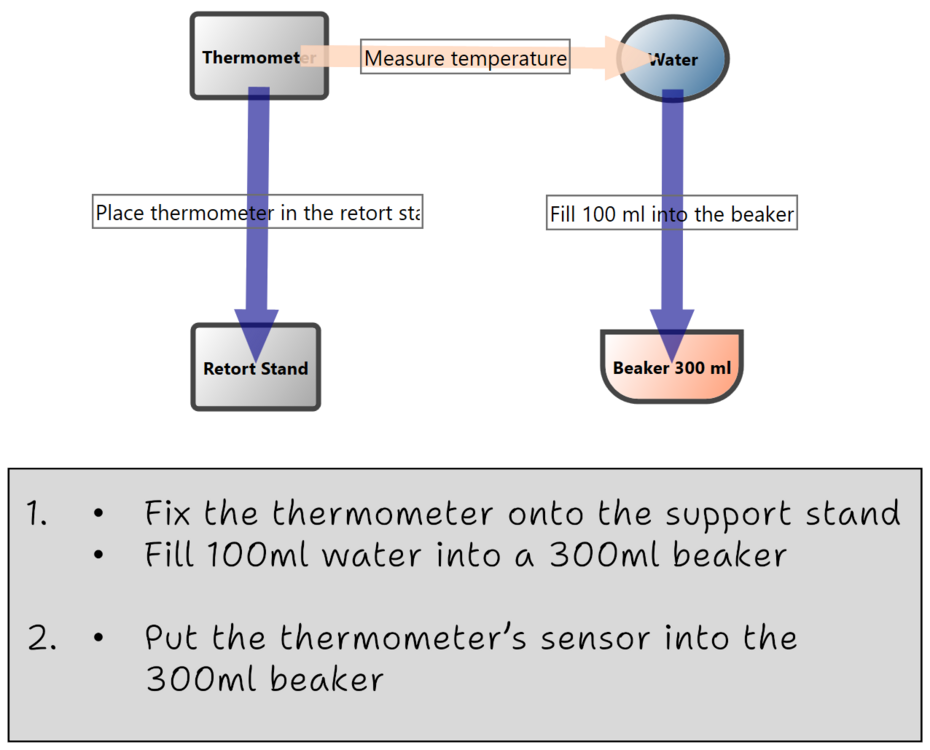
With the editor, people who cannot program may create experiment instructions. To do this, they define the experiments using blocks describing substances and devices as well as arrows that define actions with them. By grouping different actions into sets, it’s easy to model steps that can be done independently from each other.

Our vis­ion

What we already have

We already have the basis of our virtual tutor. They have simple movement and animation, they can read the eperiment instructions to students and is able to answer questions. Furthermore, the system logs all of the events that happen in the lab, detects errors and assesses the skill of students using rules.

What we want to do

To improve the tutor, we want them to adapt to the needs of the student. This means interpreting the skill level or cognitive load of a student and adjusting their strategy accordingly. A novice student might, e.g., need more detailed instructions. Additionally, the tutor should gain more knowledge of the scene and give more meaningful feedback.

Our In­s­tagram page

On our Instagram page, you can hear what the students of our current project group have to say and you can see how the project developed in the last months. Of course, appearing on our page is completely voluntary

Instagram

What work needs to be done?

The necessary work is twofold.

Improving the VR application and editor

This includes

  • Implementing new features and reworking existing ones
  • UX improvements
  • Adapting the editor to the needs of the virtual tutor and the skill evaluation
  • Making the code publication-ready

Improving the tutor’s behavior

This includes

  • Implementing a proper feedback strategy
  • Utilizing a student’s skill for adapting the feedback strategy
  • Utilizing spatial information for answering questions
  • Adapting answers to the lecture materials in the chemistry study program
  • Making the tutor more lively

You could focus on one area or dabble in both!

Im­ple­ment­a­tion

Screenshot of the Unity editor.

Unity

The VirtuChemLab is implemented using the Unity game engine. You don’t need any prior knowledge of Unity, you will get the opportunity to familiarize yourself with Unity during the project group. Similarly, you do not need to know C# beforehand.

Learn more about Unity

Interdisciplinarity

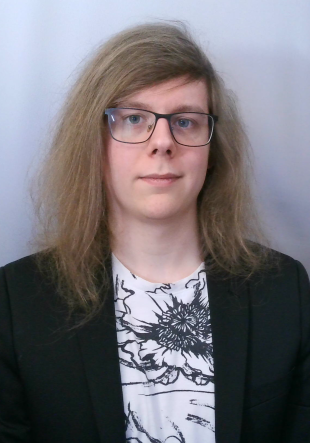
Photo of Hendrik Peeters.
Hendrik Peeters Chemistry didactics
What is your role in the project group?

The chemistry didactics group of Prof. Fechner is very much interested in the VirtuChemLab and how it can improve teaching chemistry students in their first semester.

Since programming is not our forte, we act as a form of customer to the project group students which can help us to realize our ideas. I always found this cooperation to be very fruitful. I also think that it’s very intersting to the students as ­– like work in the industry – the customers aren’t computer scientists.

What level of chemistry knowledge do you expect from the students?

None! Both me and my colleague Marvin are always eager to assist with any chemistry-related questions which might come up. Hence, the project group students do not need any knowledge about chemistry.

What do we of­fer?

A broad range of top­ics

You can work on topics in the field of 3D graphics, game engines, graphical user interface design, usability, user testing, artificial intelligence and natural language processing.

Mul­tiple VR head­sets

We have enough VR headsets ready such that you can always work comfortably without needing to worry about headset availability.

Your own pool area with power­ful PCs

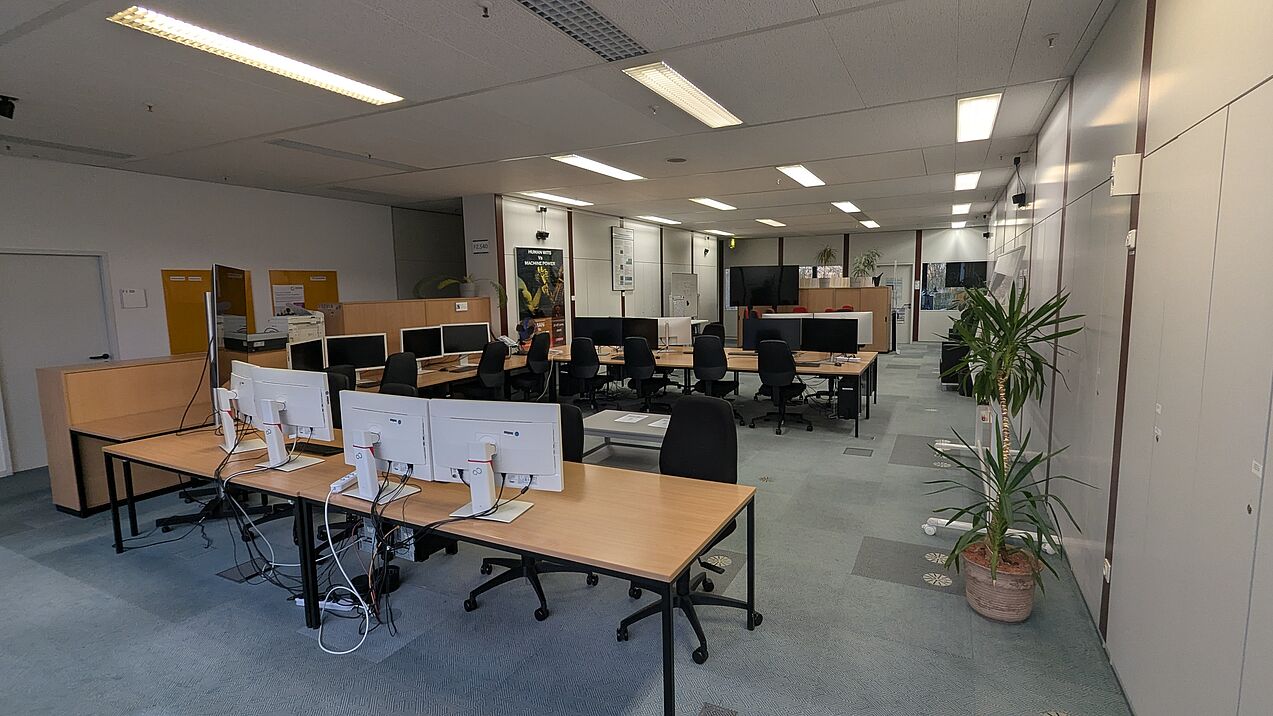
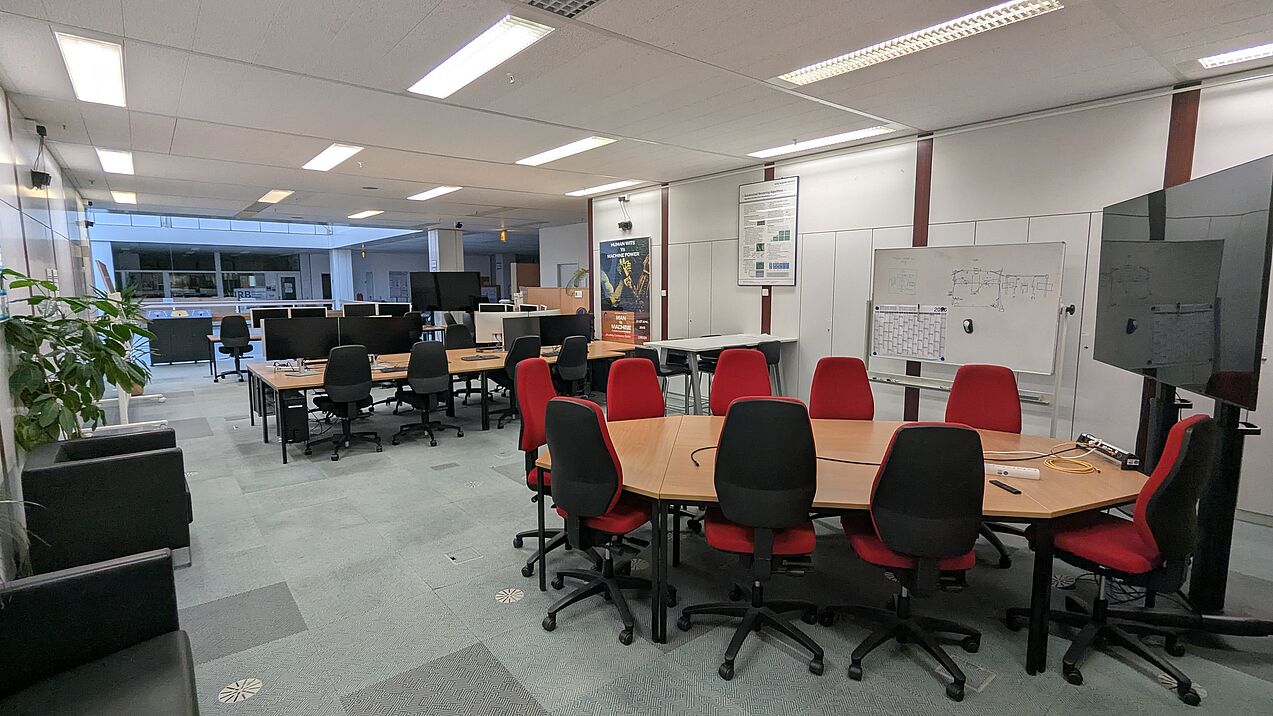
We have our own pool area on the second floor of the F building which is exclusive to our project group.

Our pool area

The team

Dr. Matthias Fischer

More about the person

Jan-Luca Hansel, M. Sc.

More about the person

Hendrik Peeters

More about the person