
Distinguished Lecture
Die Vortragsreihe „Distinguished Lectures“ des Instituts für Informatik besteht aus hochkarätigen Vorträgen und Diskussionen mit nationalen und internationalen Persönlichkeiten, die die Forschung an unserem Institut anregen und den Wissensaustausch zwischen den Wissenschaftlern fördern sollen. Die Veranstaltung ist offen für alle Interessierten. Eine gesonderte Anmeldung zur Teilnahme ist nicht erforderlich.
Martin Schulz, 12.05.2026, 14 Uhr, Foyer F0.010
The Munich Quantum Valley: Full Stack Quantum Computing with HPCQC Integration
Martin Schulz
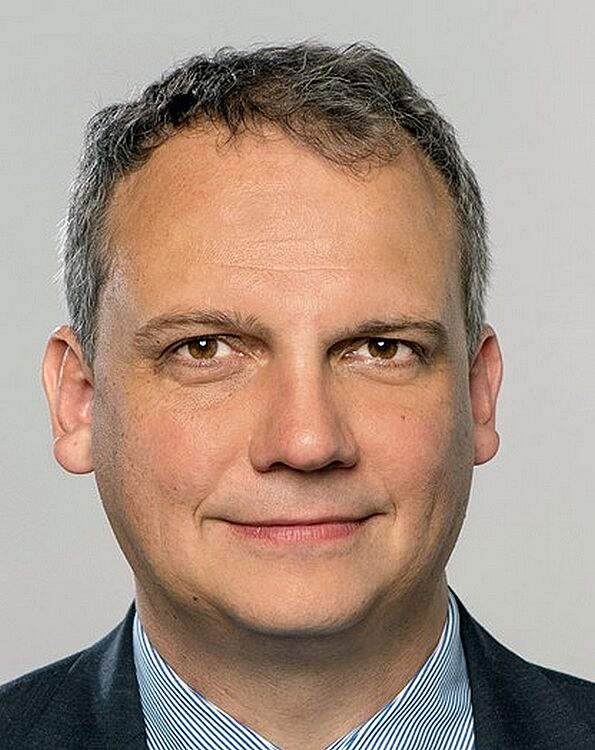
Martin Schulz is a Full Professor and Chair for Computer Architecture and Parallel Systems at the Technische Universität München (TUM), which he joined in 2017, as well as a member of the board of directors at the Leibniz Supercomputing Centre. Prior to that, he held positions at the Center for Applied Scientific Computing (CASC) at Lawrence Livermore National Laboratory (LLNL) and Cornell University. He earned his Doctorate in Computer Science in 2001 from TUM and a Master of Science in Computer Science from UIUC.
Martin's research interests include parallel and distributed architectures and applications; performance monitoring, modeling and analysis; memory system optimization; parallel programming paradigms; tool support for parallel programming; power-aware parallel computing; and fault tolerance at the application and system level, as well as quantum computing and quantum computing architectures and programming, with a special focus on HPC and QC integration.
Martin has published over 400 peer-reviewed papers and currently serves as the chair of the MPI Forum, the standardization body for the Message Passing Interface, one of the dominating standard in High-Performance Computing. He was a recipient of the IEEE/ACM Gordon Bell Award in 2006 and an R&D 100 award in 2011. He served on many conference and workshop organizing and program committees, including as program chair for ISC 2021, PC area chair at IPDPS 2021 and general chair of EuroMPI 2021, Exhibits Chair for SC23 and Tech-Program Co-Chair for SC25.
The Munich Quantum Valley: Full Stack Quantum Computing with HPCQC Integration
Abstract:
The Munich Quantum Valley (MQV) is building a fully integrated quantum computing ecosystem that spans hardware development across several modalities, control systems, and middleware through the Munich Quantum Software Stack (MQSS). The latter is explicitly designed to support HPCQC integration and HPC‑coupled software workflows, offering quantum computing as an accelerator. For this, we are currently deploying multiple quantum platforms alongside Tier‑1 HPC infrastructure to enable hybrid high‑performance and quantum computing (HPCQC). This talk will highlight MQV’s full‑stack approach to integrating superconducting, trapped‑ion, and neutral‑atom systems into an HPC environment, and the architectural choices behind the emerging MQSS software stack. I will discuss key technical and organizational challenges, from facility integration to orchestration and scheduling, and how interdisciplinary teams across MQV have addressed them.
Programm
| Dienstag, 12.05.2026, Foyer F0.010 | |
| 14:00 | Begrüßung durch Institutsleiter Prof. Dr. Axel Ngonga |
| 14:20 | Fachvortrag Martin Schulz |
| 16:00 | Get together mit Catering im “Freiraum” |
| Mittwoch, 13.05.2026 | |
| 09:00-16:00 | Personal communications mit den Fachgruppenleiter*innen |
Plakat zu Distinguished Lecture
Vorherige Vorträge in der Serie:
17.6.2025: Jérôme Euzenat
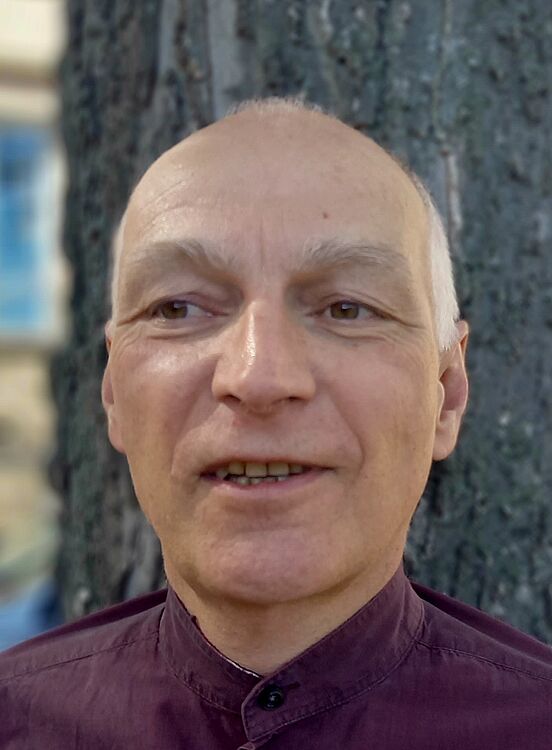
Jérôme Euzenat is senior research scientist at INRIA, Rhône-Alpes, Grenoble, France. He studied computer science at Université Paris Cité, passed his doctorate in informatics from the Joseph Fourier University of Grenoble in 1990 about reasoning maintenance systems, and hold the habilitation also from the Joseph Fourier University of Grenoble in 1999. Moreover, he have worked as an engineer for Cognitech (now EDS-ingévision 1988-1989), Bull-Cediag (1989-1991) and Ilog (1992) and joined INRIA Rhône-Alpes in 1992. He has contributed to reasoning maintenance systems, object-based knowledge representation, symbolic temporal granularity, collaborative knowledge base construction, multimedia document adaptation, belief revision and semantic web technologies. His all time interests are tied to the relationships holding between various representations of the same situation. Dr Euzenat has set up and leads the INRIA Exmo team devoted to "Computer-mediated communication of structured knowledge''. He played a leading role in the definition and development of the ontology matching field.
Cultural knowledge evolution in artificial agent societies
Abstract:
Cultural evolution is the application of evolution principles (variation, transmission, selection) to culture, e.g. customs, norms, languages, laws, religions, sciences.
It is considered as a key factor in the evolution of the human species.
Agent-based simulation of cultural evolution has been performed for long.
It has been successfully and convincingly applied to the evolution of natural languages.
We apply it to knowledge and beliefs.
Nowadays, the topics is renewed by the perspective of the deployment of artificial systems in our societies.
In order to be accepted, these systems should be able to adapt and behave along a culture shared within such societies.
Providing them with cultural evolution capabilities would contribute to their acceptance.
This is not any more cultural evolution simulation, but artificial cultural evolution, like there is artificial intelligence.
Knowing the principles by which societies can evolve their knowledge and beliefs should contribute to this.
Within this talk I will present the results of cultural ontology evolution within agents and how it allow them t succeed in their tasks, to improve their knowledge and to preserve its diversity.
I will also discuss theoretical approaches that could cover cultural knowledge evolution.
14.1.2025: Christian Kästner
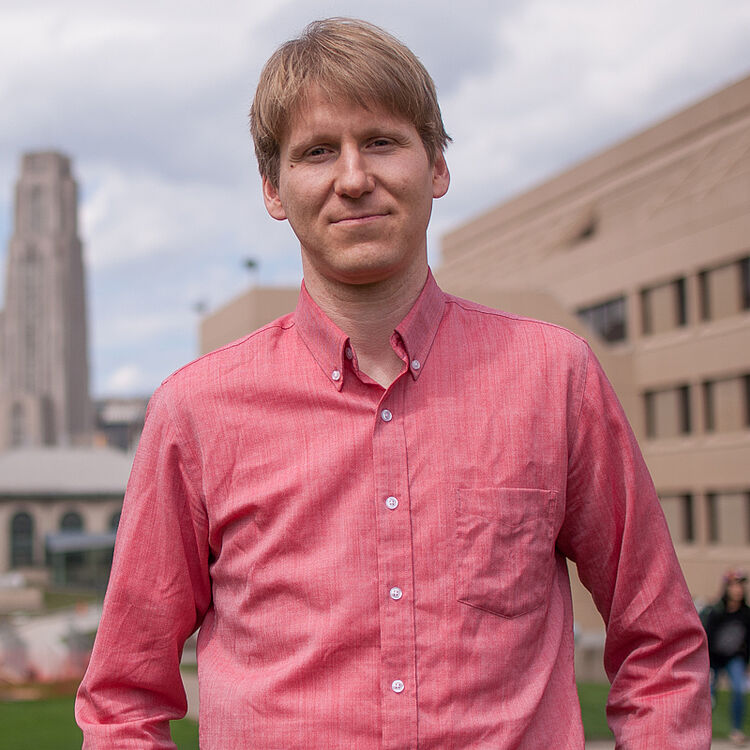
Christian Kästner ist Professor und Leiter des Software Engineering PhD Programms an der School of Computer Science der Carnegie Mellon University. Seine Forschung konzentriert sich hauptsächlich auf die Software-Analyse und die Grenzen der Modularität, insbesondere im Kontext hochkonfigurierbarer Systeme.
Dieser Vortrag ist ein Aufruf zu mehr und besserer Ausbildung an der Schnittstelle von Software-Engineering und maschinellem Lernen sowie zu mehr systemweiter Forschung zum Aufbau von Softwaresystemen mit maschinellen Lernkomponenten. Christian Kästner wird argumentieren, dass eine wirklich systemweite Perspektive erforderlich ist, wenn wir die Hoffnung haben wollen, beim Aufbau von Produktionssystemen mit maschinellen Lernkomponenten sinnvolle Fortschritte in Bezug auf Sicherheit, Benutzerfreundlichkeit, Fairness oder Schutz zu erzielen.
From Models to Systems: On the Role of Software Engineering for Machine Learning
Abstract
Building production systems with machine learning components is challenging and many projects fail when moving into production even when showing initial success with training machine-learned models. Unfortunately data science education focuses narrowly on data analysis, machine-learning algorithms, and model building but rarely engages with how the model may be used as part of a system. Engineering aspects beyond deploying models are often ignored or underappreciated, including requirements engineering, user experience design, planning and testing integration with non-ML components, and planning for evolution, leading to poor outcomes in many real-world projects. Software engineers and data scientists often clash in teams due to different goals, processes, and expectations, finding it hard to effectively coordinate and integrate work. In this talk, I argue for the important roles that software engineers have in machine learning projects that want to move beyond a prototype model. I argue that truly a system-wide perspective is needed if we want to have any hope at making meaningful progress on safety, usability, fairness, or security. I explore the common collaboration problems and discuss strategies to overcome them. This talk is a call for more and better education in this space at the intersection of software engineering and machine learning, as well as for more system-wide research on building software systems with machine-learning components.
Kontakt
Büro: F1.225
Telefon: +49 5251 60-1761
E-Mail: axel.ngonga@uni-paderborn.de
Web: Homepage