Talk in the “Distinguished Lecture” series
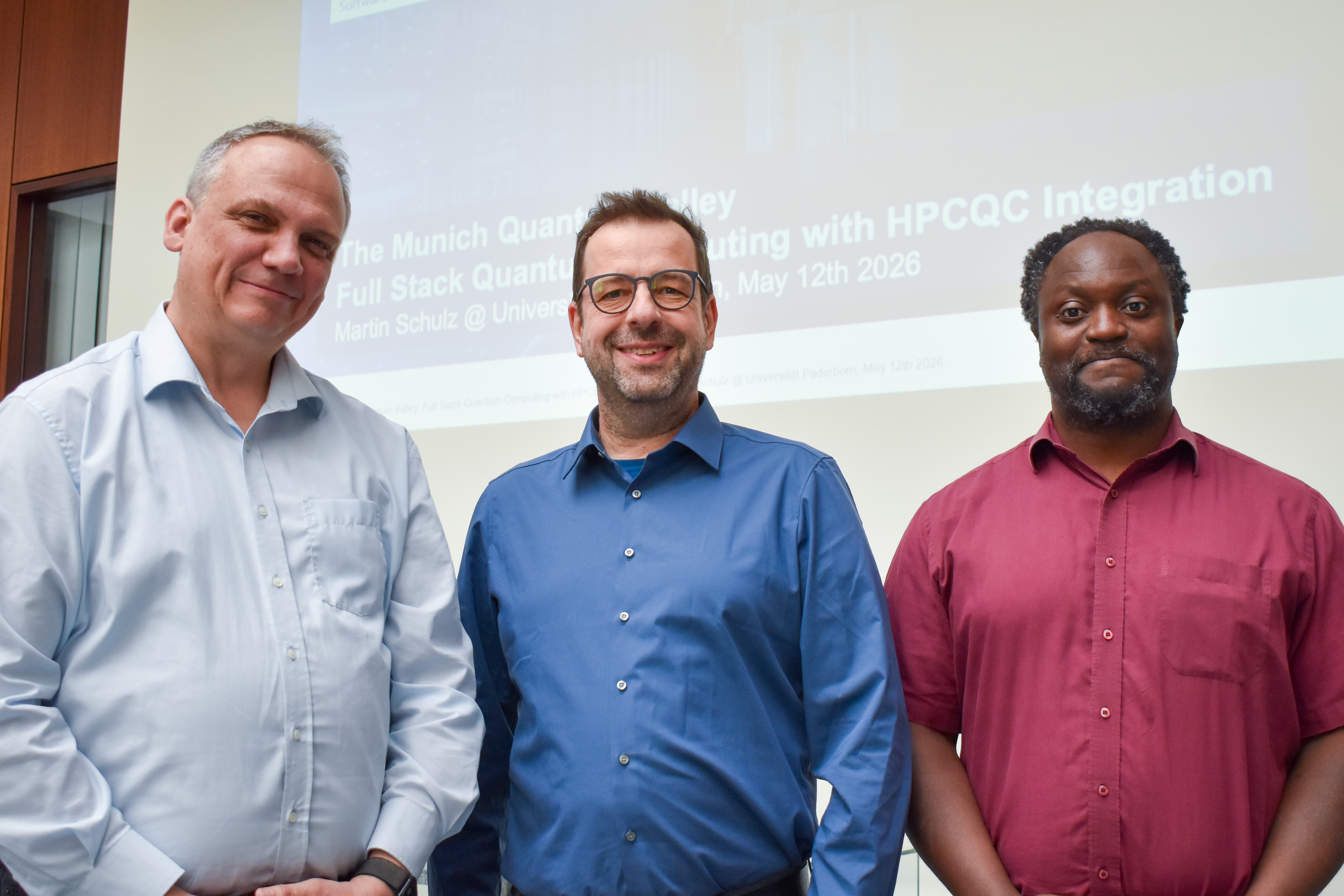
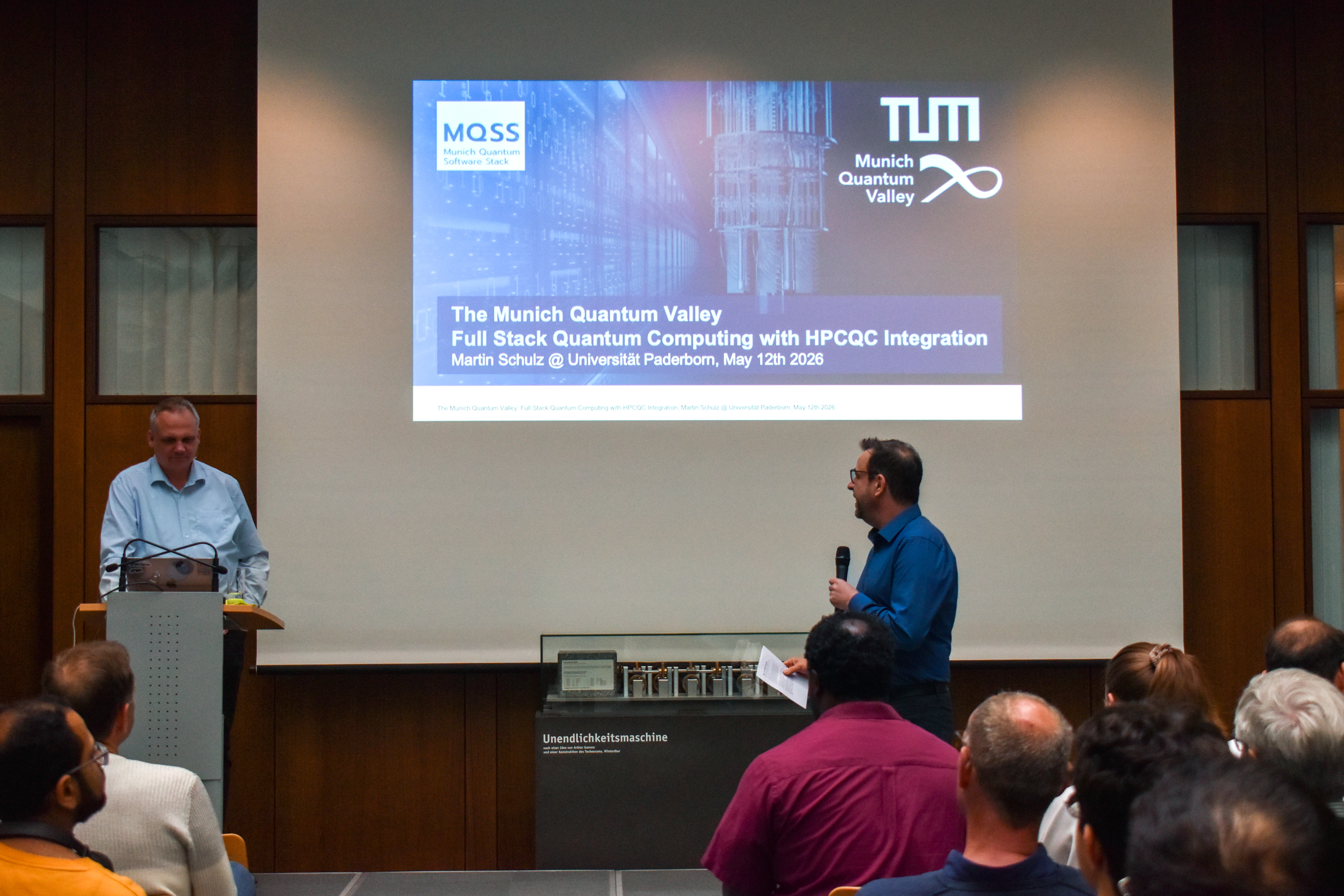
On May 12, we were pleased to welcome Prof. Dr. Martin Schulz to deliver a lecture as part of the Distinguished Lecture Series. Martin Schulz is a professor of computer architecture and parallel systems at the Technical University Munich (TUM), where he heads the CAPS (Computer Architecture and Parallel Systems) research group. He is also a key contributor to the development of the Munich Quantum Software Stack (MQSS), a central infrastructure project of the Munich Quantum Valley Initiative (MQV)—one of Germany’s most significant quantum computing initiatives, which brings together research institutions such as TUM, LMU, FAU, the Max Planck Society, Fraunhofer, and DLR.
In his presentation as part of the Distinguished Lecture Series, Professor Schulz provided a comprehensive and compelling insight into the Munich Quantum Valley and its ambitions to expand quantum computers based on a wide range of technologies—superconductors, ion traps, and neutral atoms—into an integrated research and production ecosystem. His core thesis became particularly clear: quantum computers will not replace high-performance computers (HPC)—rather, quantum accelerators are part of HPC. Instead of operating quantum systems as isolated standalone machines, his approach pursues their close integration into existing HPC infrastructures as specialized accelerators for scientific workloads, analogous to GPUs or FPGAs. This vision is already taking shape at the Leibniz Supercomputing Centre (LRZ): The Q-Exa system, a 20-qubit quantum computer from IQM that is physically operated in the same space as the classical HPC systems, has already successfully executed the first hybrid applications.
A highlight of the presentation was the introduction of the Munich Quantum Software Stack (MQSS). This is a modular framework that enables domain experts to program a wide variety of quantum computers via uniform abstraction layers—regardless of the underlying hardware technology. At the core of the MQSS is an intermediate representation (IR) based on LLVM/MLIR, which has been specifically extended to include quantum computing concepts. This design creates a modular compiler framework modeled after LLVM: different frontends allow for the description of quantum programs at a high level of abstraction, a common middle-end handles hardware-agnostic optimizations, while specialized backends handle execution on specific quantum systems. The QDMI (Quantum Device Management Interface), as an open-source interface, enables the standardized integration of new quantum systems and is already being used by a number of academic and industrial partners. This approach makes it possible to pool the diverse expertise of domain experts, quantum software developers, and quantum computer manufacturers and put it to use.
Professor Schulz impressively demonstrated the contributions that computer scientists can make to these developments: from system integration and telemetry to compiler development and runtime systems, all the way to scheduling and resource management in hybrid HPC/QC environments. This perspective aligns particularly well with the research focus at the Paderborn University, as relevant expertise is available in the areas of HPC infrastructure, system programming, and accelerator architecture.
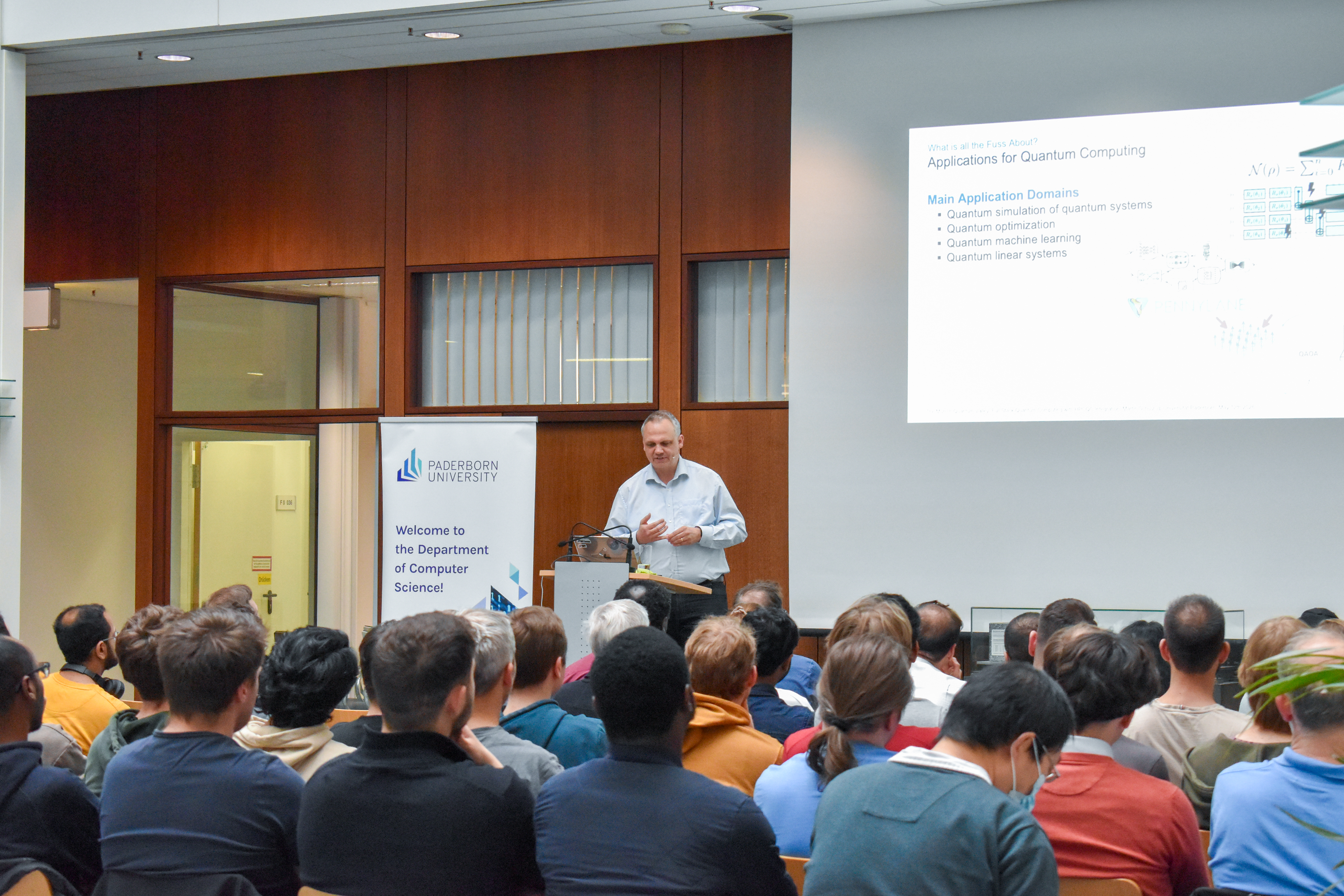
The lecture generated considerable interest: the HNI foyer, which served as the venue, was very well attended. The interdisciplinary audience, consisting of members of the departments of Computer Science, Electrical Engineering, and Physics, impressively underscored the high relevance of the topic for the Paderborn University. The subsequent Q&A session featured lively and in-depth discussions—including the question of whether the photonic quantum computers developed at the Paderborn site could potentially be integrated into the Munich Quantum Software Stack, what challenges and opportunities Professor Schulz sees for computer science in the field of quantum computing, and what potential he sees for future collaborations. The successful Distinguished Lecture provided new impetus both in terms of content and scientific exchange, and the first steps toward further collaboration are already being planned.