Welcome Days
Dear Students,
We are delighted to welcome you to the Master's programs of the Departments of Computer Science and Electrical Engineering at Paderborn University! You are now part of a diverse and vibrant academic community, and we are excited to see the perspectives and experiences you bring with you.
Starting your Master's is a significant step, with new courses, new challenges, and for many, a new country. It's natural to feel a little uncertain at the beginning, but please remember: you are not alone. There are many people and services ready to support you as you settle in and shape your own academic path.
This is your opportunity to grow academically and personally. Take time to explore your interests, get involved in projects, and connect with fellow students. Don't hesitate to ask questions, make use of the resources available, and engage with the opportunities both the university and the city of Paderborn have to offer.
We are glad you are here, and we look forward to your contributions and achievements in the semester ahed.
Welcome to Paderborn - your new academic home!
On this page you will find all material of the Welcome Days as well as general information about your study program, that might be helpful.
Welcome Days Winter 2026
For all students of the Master programs Computer Science, Computer Engineering, Electrical Systems Engineering, Optoelectronics and Photonics.
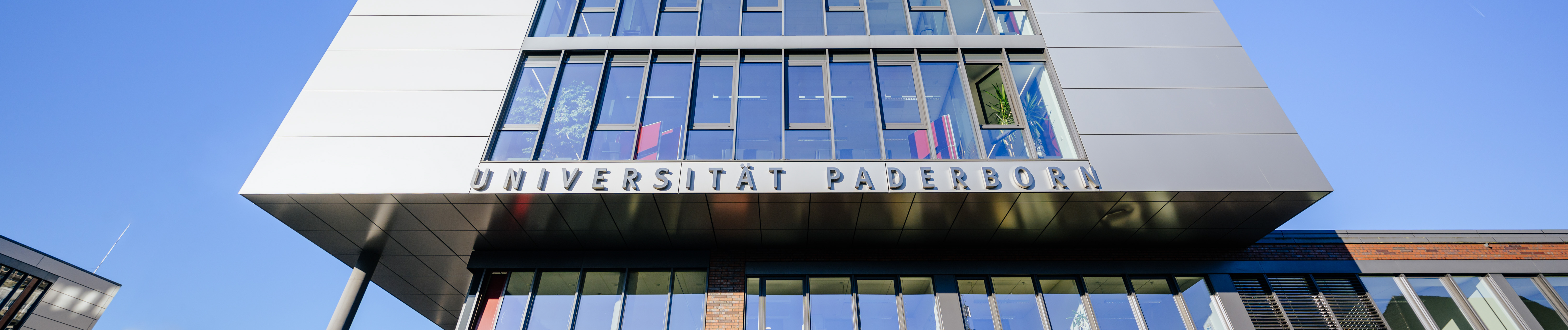
The Welcome Days will start on October 7th at 9:30am in building O (see https://go.upb.de/map for a campus map). Look out for lecture hall O1 on the ground floor at the northern end of the building. In the evening we will have a get together of the new students of the Master program in a cool location (https://asta.uni-paderborn.de/en/service-en/gewoelbe/) in the city centre. And on October 8th you will get to know the secondary campus where much of the Master program Computer Science takes place. You will also get a chance to visit one of the world’s largest computer museums, the HNF (https://www.hnf.de/).
Documents
Campus Locations & Transit Info
- Universität Paderborn: Main Campus
- Location: Warburger Straße 100, 33098 Paderborn
- Bus Stop: Uni/Südring (Bus lines 1, 4, 10, 20, 100)
- Heinz Nixdorf Institute (HNI): Fürstenallee (F building)
- Location: Fürstenallee 11, 33102 Paderborn
- Bus Stop: Museumsforum (Bus lines 9, 14)
Get-Together @ Gewölbe
Join us on October 7, 19:00 pm at Gewölbe (Marienplatz) for a relaxed evening to meet fellow students!
Entrance: floor hatch left of Hans im Glück
Presentation Slides
Study Program Overviews
Find detailed information about your chosen program at our institute. Whether you are studying Computer Science, Computer Engineering, or Electrical Systems Engineering, this is where you can explore your curriculum, course structure, and all relevant details to support your studies.


Organizing Your Studies
In the following section, you will find detailed guidance and helpful information on course registration, exam registration, and the Studium Generale, supporting you in organizing your studies effectively.
Key Deadlines
- Course Registration: until 31 October 2026
- Course Deregistration: until 31 December 2026
- Course Achievement Registration: 22 October - 26 November 2026
- Exam Registration (Phase 1): 22 October - 27 November 2026
- Exam Registration (Phase 2): 1 March - 12 March 2027
- Deregistration of Exams: up to 2 days before the exam
Course registration for the semester has already started. Once you have received your login credentials, you can register directly through the system.
The Course Catalogue in PAUL provides an overview of all modules and lectures offered this semester. Here, you can also see the approximate timetable of lectures, which will help you plan your weekly schedule.
You will find the registration section in PAUL under: Study > Semester Administration > Module and Course Registration
Understanding Course Listings
- Modules (M …): These are the main study units. You must add the module first.
- Lectures (L …): These are the actual classes you attend in a given semester. You need to register for the lecture to earn credits.
Self-Assessment Tests
Some modules provide optional self-assessment tests. These are not mandatory but can help you check if you are prepared for the course before registering.
Tips
- To register correctly, first add the module (M), then register for the corresponding lecture (L). If no lecture (L) is listed under a module, it means that module is not offered this semester.
- In your first semester, it is recommended to focus mainly on regular modules. While the standard workload is around five modules, starting with three or four is also perfectly fine. It is better to take fewer courses and perform well rather than overload yourself and struggle to keep up. Please do not register for seminars or project groups in the first semester. and give yourself enough time to adapt to both the university system and life in Germany.
- Always attend the first lecture to get a clear idea of the course. If it doesn't match your interests, deregister early and pick another option that suits you better. Register early to avoid problems with deadlines.
Registering for a course is not enough. You must also register separately for the exams in PAUL.
In PAUL, go to Study > Exam Information > Online Exam Registration
For each lecture or course, make sure you register for both:
- Studienleistung (course achievement): A course achievement can be any task related to the subject, such as assignments, projects, or presentations. Completing the course achievement is mandatory. Only after fulfilling it are you eligible to take the corresponding exam.
- Prüfungsleistung (exam): The final exam itself.
Exam Phases & Attempts
- Each semester has two exam phases.
- You have multiple attempts to pass each course exam. Have a look at your examination regulations to see, how many attempts you have (usually three to four).
- You can deregister up to 2 days before the exam date in PAUL if you decide not to take it.
- The exact phases for this semester can be found above.
Tip
- If you only register for the lecture but not for both the Studienleistung and Prüfungsleistung, you cannot complete the course.
As part of you Master's program, you are required to earn at least 10 credits in the are of Studium Generale (General Studies).
These credits can be gained by taking courses outside of Computer Science. You may choose from courses offered by other faculties, but please make sure to consult the respective faculty before registering, to confirm that the course can be counted toward your general credits.
German Courses
Many international students prefer to take German language courses as part of their general credits. The options include:
- Semester-long courses (8 ECTS)
- Semester break intensive courses (5 ECTS)
More information and registration details can be found here: go.upb.de/german_courses
Seats are limited, so it is strongly advised to register as early as possible!
First Steps in Paderborn
When you arrive in Paderborn, there are a few important formalities you must complete as part of settling in:
- City Registration (Anmeldung): All students must register their address with the city after moving into accommodation.
- Opening a Bank Account: Essential for managing rent, semester fees, and daily expenses in Germany.
- Dormitory To-Dos: If you are staying in a student dormitory, make sure to follow the move-in and administrative guidelines provided.
Complete these tasks as early as possible after arrival, as they are often required for visa extensions, payments, and university administration. Detailed guidance and step-by-step instructions can be found here: go.upb.de/step_by_step
Transportation
With the Deutschlandsemesterticket you can travel across Germany on local public transport, including buses, trams, subways, and regional trains (RB, RE, S-Bahn). The digital ticket is available through the OWL app.
Campus Life & Community
Your time at Paderborn University is more than lectures and exams - it's about joining a vibrant campus community. From student groups and cultural exchange to sports and representation, there are countless ways to connect, grow, and make lasting memories.
Study Services and Mentoring
Our Study Services are your main point of contact for all study-related questions, ranging from examination regulations and recognition of previous achievements to general guidance about your program. You can visit the Study Service during office hours or send an email.
The Study Service Computer Science also offers a YouTube live stream twice a month, where you can ask questions directly.
Mentoring (only Computer Science)
Alongside the Study Service, there is a mentoring program especially for international students. You can book one-on-one appointments via KOMO to discuss academic questions, life in Germany, or simply have an informal chat.
Find the mentoring course under: Courses > Organisation und Arbeitsgruppen > Elektrotechnik, Informatik und Mathematik > EIM.23.005 Mentoring Informatik - Master
In addition, a WhatsApp group is available for international Computer Science students, where you can share insights, ask questions, and stay connected with your peers. Don't hesitate to use these services as they are designed to support your studies and make your transition to life in Germany smoother.